Exploitation of migrant laborers in Almería
Hot MilkExploitation of migrant laborers in Almería is presented through two linked scenes: an account of undocumented workers harvesting supermarket produce in desert greenhouses, and the sight of Mexican painters whose lack of legal papers leaves them unable to answer an employer’s abuse. Together, they make migrant labor a measure of the distance between the bright, ordinary goods consumed elsewhere and the harsh working conditions obscured behind them.
Greenhouses and hidden labor
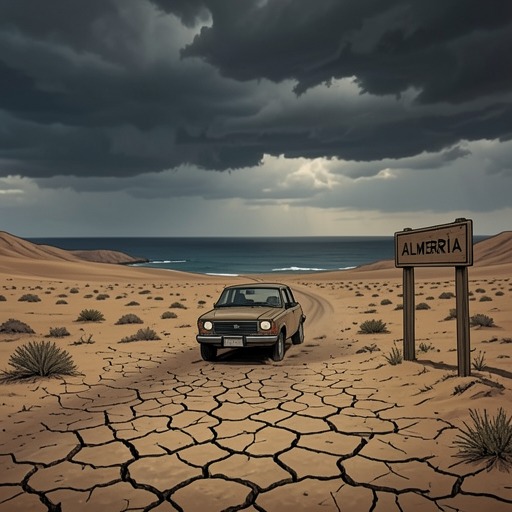
The subject first enters through a student at the beach injury hut, who suggests an original field study of the white plastic structures covering the landscape. Their reach is visible across Almería’s plains and valleys; the student identifies them as greenhouses and describes interior temperatures rising to forty-five degrees. He says that undocumented immigrants pick tomatoes and peppers for supermarkets, characterizing their employment as “more or less slavery.” The account is reported through the student rather than established by a separate investigation, but its blunt language makes the human cost of the agricultural landscape impossible to miss.
The narrator’s response to the plastic covering gives the scene a further resonance. She thinks that what is covered invites attention because concealment suggests something hidden beneath it. That association links the greenhouse roofs not only to crops but to labor that consumers do not ordinarily see. Later, she imagines the future facing a group of schoolgirls in Carboneras and wonders whether they will be able to buy tomatoes and courgettes grown in what she calls the furnace of slave farms. The produce moves from the greenhouse into everyday shopping, while the conditions of its cultivation remain easier to overlook.
Legal precarity and employer power
A related instance appears at the diving school, where Pablo shouts at two Mexican men painting walls. The narrator observes that they cannot shout back or even give him the finger because they lack the correct legal documents. Elsewhere, she explains that Pablo had sacked the unpaid Mexican workers. The scenes make legal status a practical restraint: the men’s vulnerability is not presented simply as a matter of low pay, but as a condition that sharply narrows their room to challenge the person employing or dismissing them.
The narrator recognizes an echo of that vulnerability when she drives to Julieta Gómez’s studio. She fears being stopped by the police without the right documents and compares this anxiety to the position of the Mexican workers Pablo dismissed and the immigrants laboring on the desert farms. The comparison is specific but not an assertion that their situations are identical. Her own fear brings the threat of document checks into view; the workers’ employment and inability to answer Pablo show how that threat can reinforce an employer’s power.
Work, visibility, and the narrator’s perspective
The narrative offers no extended account from the laborers themselves. Their conditions reach the reader through the student’s proposal, the narrator’s observations, and her reflections on what she sees. That limited vantage matters: the workers are made visible as people caught within harsh labor and legal constraints, but their voices and individual histories remain outside these scenes. The contrast between the student’s concrete details—the greenhouse heat, the crops, and the supermarket destination—and the workers’ absence from the narration underscores how easily their labor can be present in daily life while the people performing it remain unseen.
The narrator’s own uneasy position—as a driver who worries about documentation and a worker whose livelihood is insecure—provides a point of comparison without displacing the migrants’ distinct circumstances. Her imagined exchange of beads, shells, fish hooks, or eggs to persuade a traffic officer is explicitly a fantasy, not an actual encounter; it reveals her anxiety about the documents she lacks, rather than a solution to the workers’ exposure. Across these scenes, exploitation is registered through the ordinary landscape of covered fields, harvested food, hired labor, and the unequal freedom to answer back.